I've been growing several indigenous plants recently. Theres a miro tree that will eventually have berries. I've added karaka tawa, and hīnau to the growstuff database too, as these were (and are) food sources for the people living here for c…
Last edited on February 03, 2024. View history
Flax
How to sow flax: Direct seed outdoors
Sun requirement for flax: Plant in Full Sun
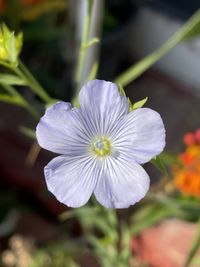
Flax is an annual, upright plant in the Linaceae family that was first cultivated in the Fertile Crescent for it's food and fibers. Flax is grown for it's seeds (which are eaten, ground into flaxmeal, added to bread, and pressed into oil), it's cellulose fibers (which are spun into linen), and as an ornamental. Flax does best in cooler climates, and can be direct seeded outdoors in the early spring as soon as the soil can be worked. Flax grows best in self-supporting patches, like grains, and should be broadcasted and raked. Seeds can be tossed with flour before sowing to help them spread evenly across the soil. Flax's slender stems grow quickly and produce pale blue flowers 15-25mm in diameter that mature into round seed pods containing 4-10 glossy brown seeds. The pods are left to dry on the plant until they turn from green to ochre or brown. Once 90% of the pods are dry, they can be harvested. Flax can also be grown as sprouts, which have a slightly spicy flavor. The seeds and oil are high in omega-3 fatty acids and are used as nutritional supplements. Flax fibers are two to three times as strong as cotton fibers and are naturally smooth and straight. Linseed meal, the byproduct from pressing oil from flax seeds, can be fed to livestock.
- 0
- plantings
- 0
- harvests
- 0
- seed packets
Flax facts
Lifespan
Height
120cmCrop cycle
Max altitude
Optimal light
What are growing degree days?
A plant grows with warmth, not with days. A growing degree day is one day's worth of useful warmth: how many degrees the day's average temperature is above the lowest temperature the crop grows at. Add them up from planting and you know how far along the crop is, whatever the calendar says.
Say that lowest temperature is 10°C. A day averaging 17°C gives 7 growing degree days. A day averaging 8°C gives none, as it is too cold for the crop to grow. That is why the same lettuce takes about 50 days in a summer and 90 in an autumn: it needs the same total warmth either way.
For flax, the FAO EcoCrop database gives a lowest growing temperature of 5°C and a shortest growing cycle of 80 days at its best temperature, about 1200 growing degree days to a first harvest.
Where you've told us where your garden is, we use this and the weather there to predict when your flax will be ready to harvest. We don't use it for how long a plant lives or when it finishes: we go by what members have logged for that.
Varieties of flax
Plant flax with
Photos
Flax crops
What people are saying about flax
Who's planted flax
Nobody has planted this crop yet.
Sign in or sign up to track your flax plantings.Flax harvests
Nobody has harvested this crop yet.
Sign in or sign up to track your flax harvests.Find flax seeds
There are no seeds available to trade on Growstuff right now.
- Purchase seeds via Ebay
- Sign in or sign up to list your seeds to trade.
Time to harvest
If sown now, expect a first harvest in about 80 to 180 days.
From the growing cycle in the FAO EcoCrop database, which is the same wherever it is grown.
Ecological requirements
Data from the FAO EcoCrop database for Linum usitatissimum (L.) Griesb.
| Family / Taxonomy | Magnoliopsida Rosidae Linales Linaceae |
|---|---|
| Killing temperature | growth: -1 °C, rest: -6 °C |
| Life form | herb |
| Life span | annual, biennial, perennial |
| Habit | erect |
| Optimal soil depth | shallow (20-50 cm) |
| Optimal soil texture | heavy, medium |
| Optimal soil fertility | high |
| Optimal soil drainage | well (dry spells) |
| Optimal soil salinity | low (<4 dS/m) |
| Photoperiod | neutral day (12-14 hours), long day (>14 hours) |
Learn more about flax
Resources outside Growstuff.