Last edited on November 29, 2025. View history
 Peanut
How to sow peanut: Direct seed. If planting indoors, harden seedlings off and transplant once soil is 15-21°C
Sun requirement for peanut: Plant in Full Sun
Peanuts are annual herbaceous plants in the Legume family that are native to South America. They are grown for their edible seed pods, which are also called peanuts. Peanuts are unique in that they grow underground. Above ground, the plants have opposite, pinnate leaves, and small, yellowish orange flowers with red veins. After being pollinated, the flower's ovary elongates and forms a "peg" that grows down into the soil and develops into the peanut. There are two types of peanuts: runner and bunch. Runner peanuts have a vining growth habit and require slightly more space than Bunch peanuts, which do not spread out. Once plants are 30 cm tall, begin hilling soil around them to ensure the pegs and developing peanuts are underground. Peanuts are a tropical plant: they need a long, warm growing season of 90-130 days and can withstand only very light spring and fall frosts. Plants are ready to harvest when the leaves turn yellow and the peanuts' inner shells have gold-marked veins (check by pulling a few nuts out and shelling them). Peanuts should be harvested before the pegs become too brittle, because then the pods will break off in the ground. Peanuts also make a good cover crop because, like other legumes, they fix nitrogen.
- 5
- plantings
- 0
- harvests
- 0
- seed packets

Peanut facts
Lifespan
Height × spread
40cm × 30cmRow Spacing
25cmCrop cycle
Max altitude
Optimal light
What are growing degree days?
A plant grows with warmth, not with days. A growing degree day is one day's worth of useful warmth: how many degrees the day's average temperature is above the lowest temperature the crop grows at. Add them up from planting and you know how far along the crop is, whatever the calendar says.
Say that lowest temperature is 10°C. A day averaging 17°C gives 7 growing degree days. A day averaging 8°C gives none, as it is too cold for the crop to grow. That is why the same lettuce takes about 50 days in a summer and 90 in an autumn: it needs the same total warmth either way.
For peanut, the FAO EcoCrop database gives a lowest growing temperature of 10°C and a shortest growing cycle of 90 days at its best temperature, about 1530 growing degree days to a first harvest.
Where you've told us where your garden is, we use this and the weather there to predict when your peanut will be ready to harvest. We don't use it for how long a plant lives or when it finishes: we go by what members have logged for that.
How members grow peanuts
Sunniness
Planted from

Plant peanuts with
 eggplant
 tansy

Photos
 Photos
Peanut crops
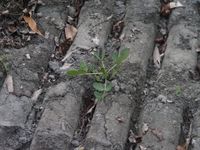
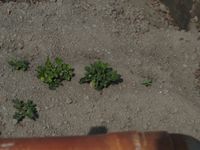
Video
Where peanuts grow
Only plantings by members who have set their locations are shown.
What people are saying about peanuts
Nobody has posted about peanuts yet.
Sign in or sign up to post your tips and experiences growing peanuts.
Who's planted peanuts
- neotoma Inside plants · Silver Spring, MD
- jelliknight Garden · Darwin, Australia
- tiki19 Drylands unirrigated food forest · Thornlie, Perth,...
Peanut harvests
Nobody has harvested this crop yet.
Sign in or sign up to track your peanut harvests.Find peanut seeds
There are no seeds available to trade on Growstuff right now.
- Purchase seeds via Ebay
- Sign in or sign up to list your seeds to trade.
Time to harvest
If sown now, expect a first harvest in about 90 to 150 days.
From the growing cycle in the FAO EcoCrop database, which is the same wherever it is grown.
Ecological requirements
Data from the FAO EcoCrop database for Arachis hypogaea L.
| Family / Taxonomy | Magnoliopsida Rosidae Fabales Leguminosae |
|---|---|
| Life form | herb |
| Life span | annual |
| Habit | prostrate/procumbent/semi-erect |
| Optimal soil depth | medium (50-150 cm) |
| Optimal soil texture | medium |
| Optimal soil fertility | high |
| Optimal soil drainage | well (dry spells) |
| Optimal soil salinity | low (<4 dS/m) |
| Photoperiod | short day (<12 hours), neutral day (12-14 hours), long day (>14 hours) |
Learn more about peanuts
Resources outside Growstuff.
