Something i've been working on is the predictions on GrowStuff.org. If you go to you gardens page there's now a progress bar for each annual planting. That's plantings that are expected to complete there lifespan in 2 years or less . the progress bar is % until the plant is finished a…
Last edited by shiny on November 10, 2026. View history
Strawberry
How to sow strawberry: Transplant bare root plants/plugs or divide runners
Sun requirement for strawberry: Plant in Full Sun
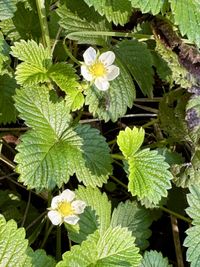
Strawberries are a hybrid species of the genus Fragaria that produce sweet, bright red fruits.
There are three main types of strawberries:
1) summer-fruiting: produce a single, large crop of fruit the year after planting. To grow, transplant plugs or crowns in early spring in rows spaced at least 120cm apart. Pinch off all flowers the first season and train the plant's runners, pressing them into the soil 15-22cm apart from the mother plant. Mulch with straw or pine needles in the fall when the plants have died back. When the plants start to grow back in the spring, move the mulch aside. After harvest the second season, set a lawnmower to about 10cm high and mow, being sure not to damage crowns.
The other two types are
2) Ever-bearing and 3) Day Neutral, both of which send out less runners and bear several crops of smaller fruit throughout the season. These two types can be grown using raised beds about 20cm high and 60cm wide. Transplant crowns or plugs in staggered double rows, about 30cm apart. Remove runners and flowers until July of the first year to give the roots time to develop, and then allow plants to produce fruit. All types of strawberries begin to produce fewer and less sweet fruit once they are two years or older. Because strawberries are a hybrid, seeds will not breed true. Strawberries are predominantly propagated using bare root plugs or crowns or dividing runners. Make sure not to bury the crown when transplanting plugs.
- 77
- plantings
- 37
- harvests
- 1
- seed packet
Strawberry facts
Lifespan
Height × spread
30cm × 30cmRow Spacing
35cmGrown for
fruit harvested 37 timesCrop cycle
Max altitude
Optimal light
What are growing degree days?
A plant grows with warmth, not with days. A growing degree day is one day's worth of useful warmth: how many degrees the day's average temperature is above the lowest temperature the crop grows at. Add them up from planting and you know how far along the crop is, whatever the calendar says.
Say that lowest temperature is 10°C. A day averaging 17°C gives 7 growing degree days. A day averaging 8°C gives none, as it is too cold for the crop to grow. That is why the same lettuce takes about 50 days in a summer and 90 in an autumn: it needs the same total warmth either way.
For strawberry, the FAO EcoCrop database gives a lowest growing temperature of 6°C and a shortest growing cycle of 180 days at its best temperature, about 2070 growing degree days to a first harvest.
Where you've told us where your garden is, we use this and the weather there to predict when your strawberry will be ready to harvest. We don't use it for how long a plant lives or when it finishes: we go by what members have logged for that.
Growing strawberries
- Dig compost into the bed 2 weeks before planting out
- Water the new plants at planting out every week
- Mulch with straw 4 weeks after planting out
- Feed with fertiliser 6 weeks after planting out every month
- Net the plants against birds 2 weeks before first harvest
- Pick ripe fruit at first harvest every week
- Cut back old leaves and remove runners 4 weeks after first harvest
- Replant with young plants 36 months after planting out
How members grow strawberries
Sunniness
Planted from
Harvested for
Varieties of strawberry
white alpine strawberry
Plant strawberries with
Photos
Strawberry crops
Strawberry plantings
Strawberry harvests
Video
Where strawberries grow
Only plantings by members who have set their locations are shown.
What people are saying about strawberries
First strawberry!
by neotoma,
I had the first tiny strawberry of the season today! I'm looking forward to many more.
Also, I transplanted a lot of seedlings into the community garden today: 2 cucumbers, 3 green beans, 2 tongue-of-fire beans, an ornamental [sweet potato](/crops/swee…
cucumbers
green beans
sweet potatoes
artichokes
lettuces
radishes
carrots
parsnips
sunflowers
strawberries
Read more
Into bed with you!
by gotica,
I finally got frustrated enough to establish one of the raised beds the other week, using a combination of enriched coir and compost.
I've sown Purple Haze carrots, brussels sprouts, purple broccoli, peas, turnips, english spinach and have transplanted two [zucchini](/crops…
spinach
zucchini
strawberries
Read more
Who's planted strawberries
- wrdnrd Canterbury — Deck · UDistrict, Seattle,...
- broderick Tub garden · Canberra
- valgrind Vegetable Garden
- trishf42 Raised Veg Garden 3 · Woomelang, AU
- shiny Front berries garden · Wellington, NZ
Strawberry harvests
-
trishf42 harvested 15.
3 days ago
-
trishf42 harvested 15.
3 days ago
-
trishf42 harvested 15.
12 days ago
Find strawberry seeds
- Purchase seeds via Ebay
- Sign in or sign up to list your seeds to trade.
Nutritional data
A summary of nutritional data per 100g for Strawberry, raw.
| Energy | 108.0 kJ |
|---|---|
| Protein | 0.7 g |
| Fat, total | 0.2 g |
| Carbohydrate | 3.9 g |
| - Sugars | 3.8 g |
| Fibre | 2.5 g |
Time to harvest
If sown now, expect a first harvest in about 180 to 270 days.
From the growing cycle in the FAO EcoCrop database, which is the same wherever it is grown.
Ecological requirements
Data from the FAO EcoCrop database for Fragaria x ananassa (Duchesne) Guédes
| Family / Taxonomy | Magnoliopsida Rosidae Rosales Rosaceae |
|---|---|
| Life form | herb |
| Life span | perennial |
| Habit | acaulescent (or rosette plants) |
| Optimal soil depth | shallow (20-50 cm) |
| Optimal soil texture | medium, organic |
| Optimal soil fertility | moderate |
| Optimal soil drainage | well (dry spells) |
| Optimal soil salinity | low (<4 dS/m) |
| Photoperiod | short day (<12 hours), neutral day (12-14 hours), long day (>14 hours) |
Learn more about strawberries
Resources outside Growstuff.